
Best Motorcycle Roads in Arkansas
Arkansas doesn't advertise itself the way Tennessee or Colorado do, and that's exactly why the riding here is so good. Two separate mountain ranges — the Ozarks in the north and the Ouachitas in the south — pack the state with sustained curves, forest canopy, and roads that see little traffic outside of locals and riders who've done their homework. The Pig Trail has national name recognition, but Push Mountain Road quietly delivers more turns per mile, Scenic Highway 7 stitches both ranges together over 160 miles, the Talimena Scenic Drive hands you unbroken ridgetop views across two states, and the Trans-America Trail's Arkansas crossing is widely considered the finest dirt-road riding in the eastern half of the country. Whatever you're on — sport, bagger, dual-sport, or ADV — there's a route here that suits it.
- Routes
- 1
- Best season
- Spring & fall; summer workable
- Helmet law
- Required under 21 only
- Eye protection
- Required, all ages
- Lane splitting
- Not permitted
The routes
Arkansas sits at the geographic crossroads of two mountain systems that run perpendicular to almost every other range in the country. The Ouachitas trend east–west rather than north–south — one of only a handful of ranges in North America oriented that way — and the result is a ridge-riding experience you can't replicate in the Appalachians or the Rockies. The Ozarks, meanwhile, are a dissected plateau, not a classic range, which means the hollows are deep and the roads that cross them are relentlessly varied.
Matching the Route to Your Bike
The five routes on this page cover a wide range of terrain and riding styles:
- Pavement, technical focus: Push Mountain Road (AR-341) is the tightest paved option — 135-plus turns in 24 miles with excellent surface conditions. AR-123 from Lurton to Mt. Judea runs even tighter and suits sportbike riders specifically.
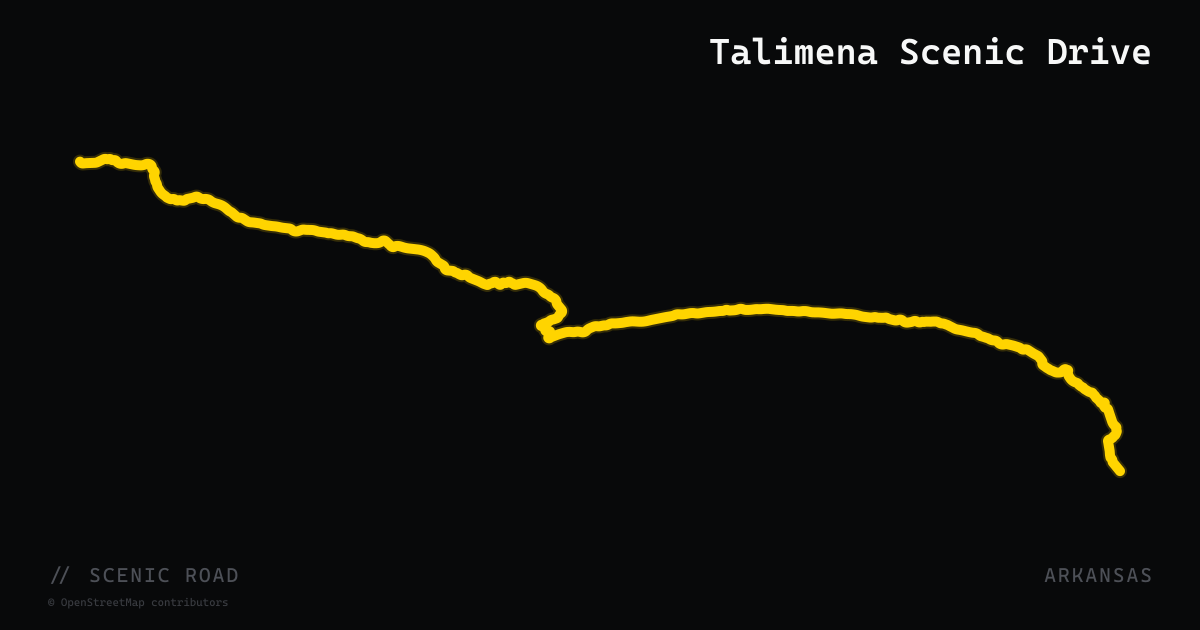
- Pavement, scenic touring: Scenic Highway 7 (Hot Springs to Harrison) and the Talimena Scenic Drive are both well-suited to heavier bikes. Highway 7 crosses both national forests; Talimena keeps you on the ridgeline for its entire 54 miles.
- Dirt and mixed surfaces: The Trans-America Trail's Arkansas section (~450 miles) is built for dual-sport and ADV machines. Fuel planning matters — services thin out considerably in the Ouachita and Ozark national forest sections.
Seasonal and Road Hazards to Know
Spring brings the best wildflower and river scenery but also the highest chance of wet pavement and occasional debris from seasonal runoff — this is especially true on the Pig Trail, where road sections have washed out during heavy rain years. Talimena's ridge road carries no winter maintenance, so ice and snow make it genuinely risky from late November through early March. Cell coverage drops to zero in multiple sections across all five routes; download offline maps before you leave.
Wildlife crossings are common in both mountain systems — deer are the main concern at dawn and dusk, and black bears are present in the Ouachita National Forest. Gravel carried onto road surfaces at rural intersections is a regular hazard on the smaller county roads that connect the named byways.
Planning Notes
Most riders base out of Mena (Ouachitas/Talimena), Mountain Home (Push Mountain), or a town along Highway 7 for multi-day trips. The Ozark and Ouachita national forests offer dispersed camping that works well for TAT riders. Annual motorcycle events in Rogers and Fort Smith draw large crowds in spring — if you prefer lighter traffic, avoid those weekends or use them as anchors for a longer loop.
Frequently asked
Does Arkansas require motorcycle helmets?+
Arkansas does not have a universal helmet law. Riders and passengers under 21 are required by law to wear a helmet (Arkansas Code § 27-20-104). Riders 21 and older are not legally required to wear one, but all riders regardless of age must wear eye protection — glasses, goggles, or a face shield. Wearing a helmet is strongly recommended regardless of what the law mandates.
Is lane splitting legal in Arkansas?+
No. Lane splitting is not referenced as a permitted practice in Arkansas law, and motorcyclists are subject to the same traffic laws as other drivers. Treat it as prohibited.
What is the best time of year to ride in Arkansas?+
Spring and fall are generally considered the best seasons — mild temperatures, good visibility, and peak foliage on routes like the Pig Trail and Push Mountain Road. Summer brings heat and humidity but is manageable in the mountains. Winter riding in northern Arkansas carries real risks from snow and ice, particularly on high-elevation roads like the Talimena Scenic Drive, which has no winter road maintenance.
Is the Talimena Scenic Drive open year-round?+
The road itself is open year-round on paper, but the byway receives no winter maintenance. Snow and ice on the ridge sections make winter travel genuinely hazardous, and the U.S. Forest Service visitor centers are only open seasonally (roughly mid-April through mid-November). Plan your ride for spring through fall for reliable conditions.
Which Arkansas roads are best for dual-sport or ADV bikes?+
The Trans-America Trail (TAT) is the standout choice — its Arkansas crossing runs roughly 450 miles from Helena to the Oklahoma state line and is widely regarded as among the finest riding on the entire TAT route. The April–early June and September–October windows are best for the TAT in Arkansas. The Oark General Store, established in 1890, is the classic midpoint stop.
Which route is best for a first-time visitor to Arkansas?+
Scenic Highway 7 (Hot Springs to Harrison, ~160 miles) is the most accessible introduction: it's Arkansas's first National Scenic Byway, crosses both the Ouachita and Ozark National Forests, and suits any style of bike. Riders looking for a shorter, more technical introduction should head straight to the Pig Trail Scenic Byway (AR-23), which packs 19 miles of Boston Mountain hairpins into a manageable half-day ride.
When to ride
Spring (April–early June) and fall (mid-September–October) are the prime windows: temperatures are moderate, the forests are vivid, and mountain rain is manageable with basic gear. Summer riding is entirely doable, especially at elevation in the Ozarks, but expect heat and humidity in the valleys — mesh gear and early starts help. Northern Arkansas can see snow and icy roads in winter, and the Talimena Scenic Drive is not maintained during winter weather, so the byway is effectively a three-season road; the central and southern parts of the state stay milder and are accessible most of the year.
+Sources & references (10)
- Arkansas Motorcycle Helmet Laws | Rainwater, Holt & Sexton
- Arkansas Motorcycle Laws | Law Offices of Alan LeVar
- Arkansas Motorcycle Laws: What Every Rider Needs to Know | McMath Woods
- What States Have Motorcycle Helmet Laws? | Law Tigers
- Arkansas Motorcycle Rides | Explore The Best Routes & Rides — REVER
- 7 Best Motorcycle Rides in Arkansas 2026 — GreatMotorcycleRoads.com
- Talimena National Scenic Byway — Ouachita National Forest, USDA Forest Service
- Talimena Scenic Drive Full Road Trip Guide — The Courtney Lux Blog
- Queen Wilhelmina Talimena Scenic Drive — Arkansas State Parks
- Motorcycling in Arkansas — Arkansas.com