
Best Motorcycle Roads in Virginia
Virginia packs more riding variety into one state than most riders expect. The Blue Ridge spine runs the entire western edge, giving you two national-parkway-grade ridge roads that connect end to end — Skyline Drive through Shenandoah, then the Blue Ridge Parkway all the way to the North Carolina line. Drop off the ridge and you find Route 39 threading a river gorge through George Washington National Forest, VA-16 switchbacking over three mountains in Southwest Virginia, and the Mid-Atlantic BDR threading 500-plus miles of national forest two-track from Damascus to the West Virginia border. The terrain shifts from pastoral Shenandoah Valley farmland to tight Appalachian hollows depending on which road you choose, and the riding season runs long enough to hit each one at its best.
- Routes
- 1
- Best season
- Late spring–fall
- Helmet law
- Required, all riders (universal)
- Lane splitting
- Illegal
- Signature terrain
- Blue Ridge ridge roads & Appalachian hollows
The routes
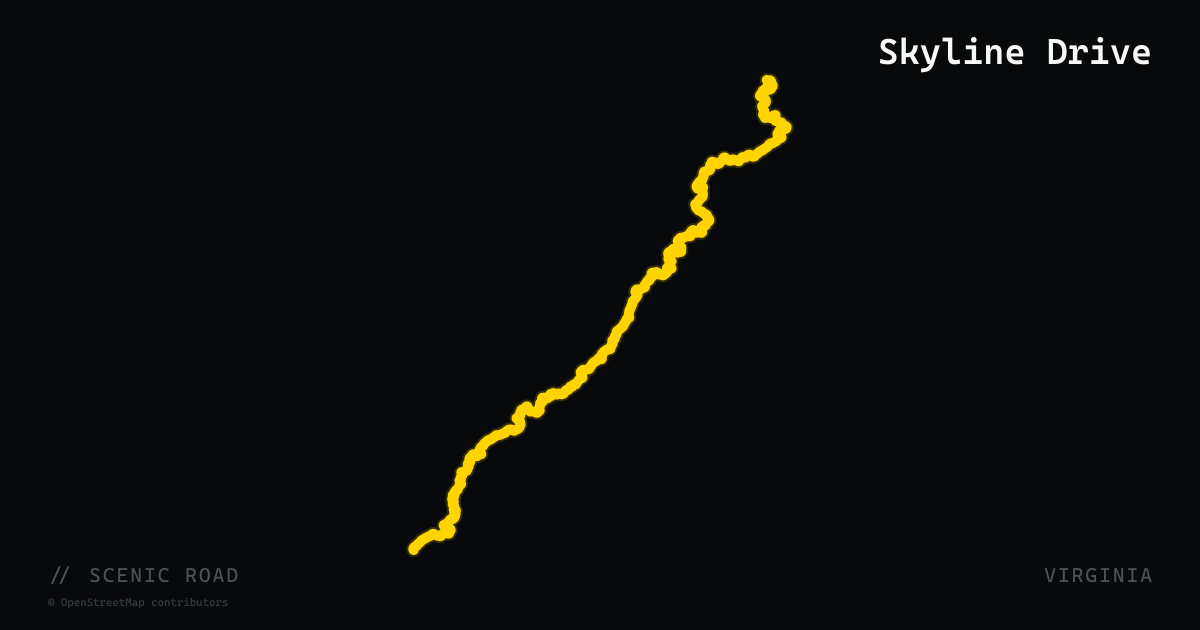
Virginia earns its reputation as a riding destination on the strength of its western mountains, but the routes here are not all the same kind of ride. Choosing among them means matching the road to your bike and your day.
Picking the Right Route for Your Bike
The ridge roads — Skyline Drive and the Blue Ridge Parkway's Virginia section — suit any motorcycle. Both are paved, well-maintained national parkway roads with low posted speed limits and predictable surfaces. They reward patience and attention to overlooks more than aggressive cornering. Touring bikes, baggers, and sport bikes all fit here.
Route 39 through Goshen Pass is a step up in engagement: the Maury River gorge tightens the road and introduces blind corners over water. Still fully paved and manageable, but worth a slower pace on a first pass.
The Back of the Dragon (VA-16) is the most technically demanding of the paved routes — 438-plus curves over three mountains, with real elevation change. It's Virginia's only state-designated motorcycle route, and the pavement is kept in good shape, but the combination of switchbacks and gradient changes calls for full attention. It also works well for baggers, which sets it apart from similar roads in the region.
The MABDR's Virginia sections are a different category entirely: several hundred miles of unpaved forest roads through George Washington and Jefferson National Forests. Plan for an adventure or dual-sport bike and multiple days.
Seasonal and Safety Considerations
The Appalachian ridge roads carry real winter risk. Neither Skyline Drive nor the Blue Ridge Parkway is plowed or treated for ice — both close when conditions deteriorate, and sections can remain shut for extended periods in late fall through early spring. Even in shoulder seasons, ridge elevations can be icy when valley roads are dry. Check current conditions before riding either road outside the core spring-to-fall window.
Wildlife crossings are frequent on Skyline Drive — deer and black bears cross without warning, especially at dawn and dusk. The 35 mph limit is practical, not just regulatory.
On all the Southwest Virginia mountain roads, afternoon thunderstorms are common in summer. Pack rain gear regardless of the morning forecast, and watch for gravel washed across the road after storms.
Combining Routes
Rockfish Gap is the natural hinge of a Virginia mountain trip: Skyline Drive ends here heading south, and the Blue Ridge Parkway begins, running another 217 miles to the North Carolina line past Humpback Rocks, Peaks of Otter, and Mabry Mill. The two roads link cleanly into a multi-day ridge ride without retracing any miles. Pair that with a loop down to Route 39 and back up via the Warm Springs area, and you have a long weekend that covers most of what makes Virginia worth riding.
Frequently asked
Is a helmet required to ride a motorcycle in Virginia?+
Yes. Virginia has a universal helmet law: all operators and passengers must wear a helmet that meets or exceeds DOT, Snell, or ANSI standards. Eye protection — a face shield, safety glasses, or goggles — is also required unless the bike has a windshield. There are no age exemptions.
Is lane splitting legal in Virginia?+
No. Lane splitting remains illegal in Virginia. A motorcycle is entitled to the full width of its traffic lane, and no other vehicle may share that lane.
When is the best time of year to ride Skyline Drive?+
Spring and fall are the sweet spots — wildflowers appear in April and May, and fall foliage peaks in October. Summer works well for cooler ridge temperatures. Winter brings real closure risk: Skyline Drive is not plowed, and ice can form on the ridgeline even when valley roads are clear. Check current conditions before riding in the off-season.
Does Skyline Drive charge a fee for motorcycles?+
Yes. Shenandoah National Park charges a $25 entry fee for a 7-day motorcycle pass. The Blue Ridge Parkway, which connects at Rockfish Gap, has no entry fee.
What's the difference between Back of the Dragon and the Tail of the Dragon?+
Virginia's Back of the Dragon (VA-16) covers 32 miles between Marion and Tazewell with roughly 438 curves and 3,500 feet of elevation change. It is Virginia's only state-designated motorcycle route and mixes tight switchbacks with open sweeping sections, making it more approachable for touring and adventure bikes than the Tennessee/North Carolina Tail of the Dragon.
Is the MABDR suitable for street motorcycles?+
Not really. The Mid-Atlantic BDR's Virginia sections (Damascus to Moorefield, WV) run through George Washington and Jefferson National Forests on unpaved forest roads. It is the least technically difficult of all the BDR routes, but it is designed for adventure and dual-sport bikes with off-road capability, not for street-only motorcycles.
When to ride
Virginia's lower-elevation roads are rideable for most of the year, but the mountain routes — Skyline Drive, the Blue Ridge Parkway, and Route 39 — are best from spring through fall. Both Skyline Drive and the Blue Ridge Parkway are subject to weather-related closures in winter, as neither road is plowed or treated for ice and snow; sections can close from late fall through early spring. Fall foliage, typically peaking in October, draws the most traffic on the ridge roads — a midweek visit avoids the worst weekend congestion.
+Sources & references (10)
- Motorcycle Riding in Virginia — Virginia Is For Lovers
- Virginia Motorcycle Events: Culture, Clubs, and Scenic Rides — Law Tigers
- 7 Best Motorcycle Rides in Virginia — GreatMotorcycleRoads.com
- Virginia Motorcycle Roads — REVER
- § 46.2-910 — Virginia Motor Vehicle Code (helmet law)
- Virginia Motorcycle Helmet Laws — Smith Law Center
- Five Laws Every Motorcycle Rider in Virginia Must Know — The Johnson Injury Firm
- Blue Ridge Parkway FAQs — Blue Ridge Parkway Association
- Blue Ridge Parkway — Wikipedia
- The Guide to Visiting Skyline Drive and the Blue Ridge Parkway in the Fall — Virginia.org